
Working under CIS can provide a good income, particularly for people working in the construction industry. However, there is one important consideration: your income often depends directly on your ability to continue working.
If an illness or injury prevents you from working for several weeks or even months, your usual income may fall significantly. At the same time, your mortgage or rent, bills, credit commitments and everyday expenses do not disappear.
For this reason, Income Protection can be an important financial protection option for people working under CIS.
However, when choosing this type of insurance, it is important to consider more than just the potential monthly benefit. The waiting period, your occupation, the insurer’s terms and any additional benefits included in the policy can all matter.
How Does Income Protection Work for CIS Workers?
The main purpose of Income Protection is to protect part of your income if you are temporarily unable to work due to your health, provided your circumstances meet the terms and conditions of the policy.
For someone doing physical work, the ability to continue carrying out their usual occupation can be particularly important.
For example, even an injury that is not considered a critical illness could prevent you from doing your normal job for a period of time.
Income Protection should not be confused with Critical Illness Cover or Serious Illness Cover. With Income Protection, the key question is not simply what diagnosis you have, but whether your health prevents you from working according to the definition of incapacity in your policy.
Payments Do Not Start Immediately: What Is a Deferred Period?
One of the most important things to understand before taking out Income Protection is the Deferred Period.
This is the waiting period between the point when you become unable to work due to your health and the point when payments may begin following an approved claim.
Depending on the product and insurer, a Deferred Period could be, for example, 4, 8, 12 or 26 weeks.
Suppose your policy has an 8-week Deferred Period. This means that your insurance benefit would not start from the first day you are unable to work. The specified waiting period would need to pass first.
This is why, when considering Income Protection, it is worth asking:
How would I cover my expenses during the Deferred Period?
You may need to rely on personal savings, other sources of income or other financial support available to you.
Therefore, it is not enough to compare policies based only on the monthly benefit. You should also understand when those payments could begin.
Why Does Your Occupation Matter?
Not every insurer assesses occupations in the same way.
Terms may differ for certain types of physical work. An insurer may consider the nature of your job, your actual duties and the risks associated with your occupation.
As a result, two people with similar incomes but different occupations may have different insurance options available to them.
It is particularly important to provide accurate information about your occupation and the work you actually perform when applying for cover.
The aim is not simply to find an Income Protection policy, but to choose a product whose terms are appropriate for your actual work.
What Is Fracture Cover?
For people working under CIS, another potentially relevant additional benefit is Fracture Cover.
Imagine that you do not have a critical illness, but you fracture your arm, leg, wrist or another bone covered by the terms of your policy.
The fracture may temporarily prevent you from doing your job, while your financial commitments continue.
Some insurance products provide an additional cash benefit for certain types of fractures.
It is important to understand that Fracture Cover is generally an additional benefit and does not replace Income Protection.
What Is the Difference Between Fracture Cover and Income Protection?
These two types of protection serve different purposes.
Income Protection is designed to protect part of your income when your health prevents you from working and the conditions of the policy are met.
Fracture Cover may provide a separate payment for certain fractures if they meet the criteria of the selected product.
Another important difference is the waiting period.
Income Protection may have a Deferred Period. With Fracture Cover, under certain products, a payment may be made following confirmation of an eligible claim without the same waiting period applying.
This can be particularly useful during the first few weeks following an injury, before Income Protection payments have started.
Important: the claims process, assessment times and when a payment is made will depend on the insurer and the terms and conditions of the specific policy.
Does Fracture Cover Reduce Income Protection Payments?
Where Fracture Cover is provided as a separate additional benefit, it may be paid separately and does not replace the main Income Protection cover.
For example, someone suffers a fracture covered by their policy and receives the relevant Fracture Cover benefit. If their health continues to prevent them from working for long enough, they may also become eligible for Income Protection payments after the Deferred Period, provided the claim meets all the policy requirements.
The two types of protection should therefore not be viewed as interchangeable.
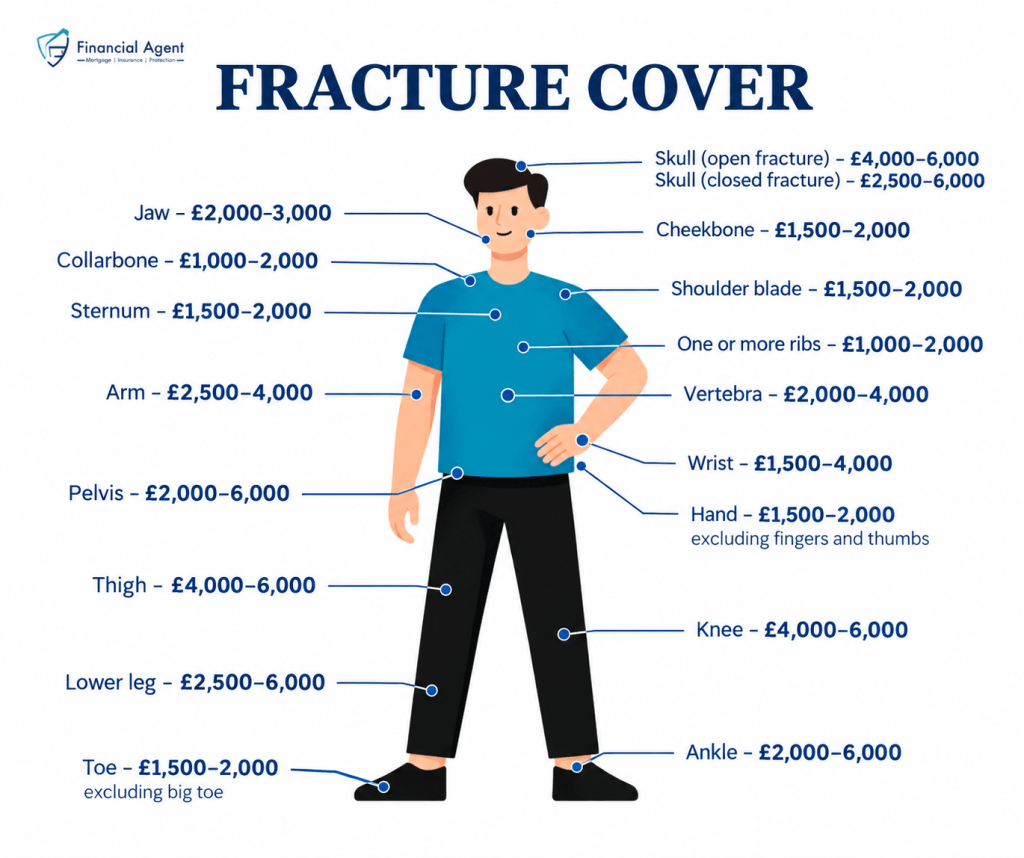
How Much Could You Receive for a Fracture?
The amount paid depends on the specific insurance product and the type of fracture.
Under some policies, payments for certain fractures may reach several thousand pounds, but there is no single amount that applies to every insurer or every type of fracture.
The product terms will normally specify which fractures are covered and the amount payable for each eligible injury.
Before taking out cover, it is therefore important to check not only whether Fracture Cover is included, but also which fractures are covered, how much could be paid and what exclusions apply.
Why Should You Consider Income Protection Before You Need It?
The cost and availability of insurance can be affected by several factors, including your age, health, occupation, income and the level of protection required.
For this reason, financial protection is better considered before a problem occurs.
If an illness or injury has already happened, you cannot take out insurance afterwards to cover that event retrospectively. Existing medical circumstances may also affect the terms available under a new policy.
What Should CIS Workers Consider?
If you work under CIS and are considering Income Protection, it is important not to choose a policy based only on the lowest monthly premium.
You should understand how much of your income can be protected, what Deferred Period applies, how long benefits could be paid for, whether the product is suitable for your occupation, what terms and exclusions apply, and whether additional benefits such as Fracture Cover are available.
Every situation is different. What is suitable for one CIS worker may not be suitable for another. The availability of cover, cost, benefit amounts and additional options will depend on the insurer, the product selected and the client’s individual circumstances.
This post is for information purposes only and does not constitute financial or insurance advice.