Many homeowners think about remortgaging in the UK in a fairly simple way: the fixed rate is coming to an end, so it is time to find a new rate and continue paying the mortgage.
In reality, remortgaging can also be a good opportunity to review the entire structure of your mortgage: the remaining term, monthly payments and the products available to you.
A recent case from our practice demonstrates this well. After reviewing the available options, our clients were able to reduce their mortgage term by 5 years without increasing their monthly payment.
What Was the Initial Situation?
Two years ago, the clients approached us to find a suitable mortgage solution.
At the time, their main priority was to keep the monthly payment as comfortable as possible for their family budget. After reviewing the options, we arranged a mortgage with a 34-year term, running until age 75.
The longer term helped reduce the monthly payment.
For their circumstances at that time, this was a suitable solution.
Two years later, the clients returned to us for a remortgage.
At that point:
- the remaining mortgage term was 32 years;
- the monthly payment was approximately £1,045;
- a new mortgage product was required.
We could simply have found a new rate. Instead, we looked at whether there were other opportunities available.
Why Should You Look Beyond the Interest Rate When Remortgaging?
During the remortgage process, we compared products from the clients’ existing lender, options from other lenders and different mortgage terms.
Changing the mortgage term produced an interesting result.
With 32 years remaining, the range of lenders and mortgage products available to the clients was more limited. One of the factors affecting the options was their age at the end of the mortgage term.
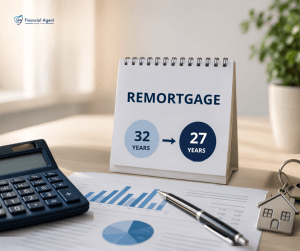
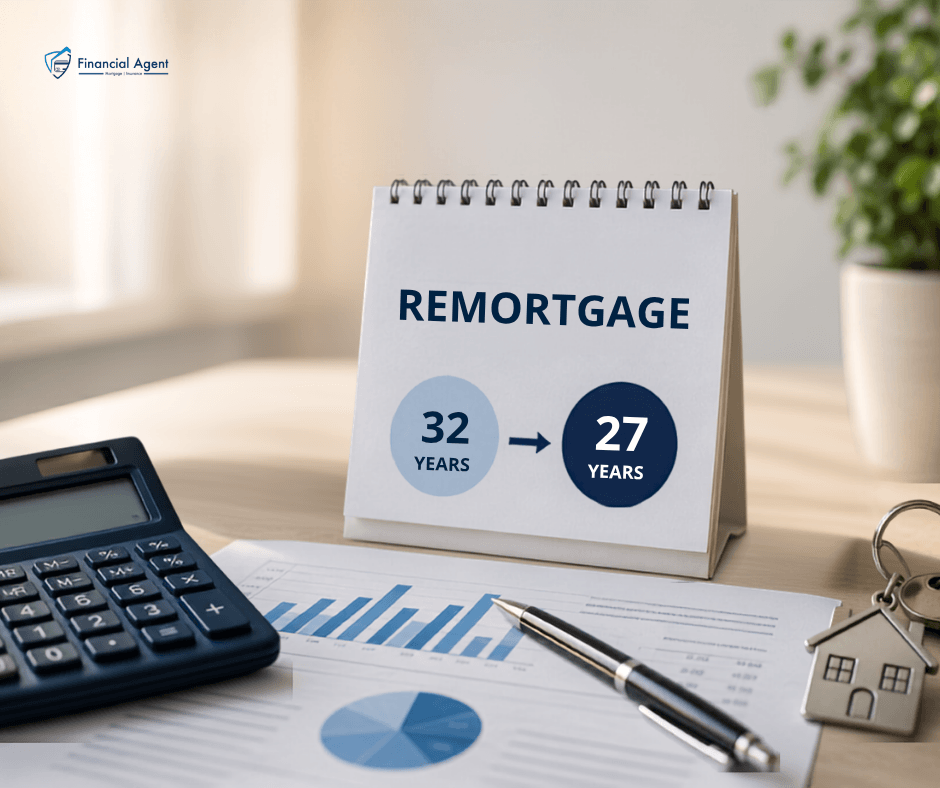
We therefore calculated an alternative scenario: what would happen if the mortgage term were reduced by 5 years, from 32 years to 27 years?
This opened up access to a wider range of lenders and products.
The key question, however, was what would happen to the monthly payment.
5 Years Off the Mortgage Without a Higher Monthly Payment
The results were particularly interesting.
Before the remortgage, the clients were paying approximately:
£1,045 per month.
Under the new option with a 27-year term, the monthly payment was approximately:
£1,035 per month.
This meant that the remaining mortgage term was reduced by 5 years, while the monthly payment did not increase. In this particular case, it actually decreased slightly.
Of course, this does not mean that shortening a mortgage term will always result in a lower monthly payment.
The outcome depends on factors such as the outstanding mortgage balance, available interest rates, the clients’ age and income, and individual lender criteria.
This is why every remortgage needs to be assessed individually.
Why Does Your Age at the End of the Mortgage Matter?
When assessing a mortgage application, lenders may consider not only your current age but also how old you will be when the mortgage term ends.
Different lenders have their own maximum age criteria and requirements regarding income later in life.
In the clients’ original situation, extending the mortgage to age 75 allowed them to achieve the comfortable monthly payment they needed.
Two years later, their circumstances and the options available made it possible to consider a different structure.
Reducing the remaining term to 27 years means the mortgage is due to finish earlier. This may help broaden the range of potential lenders, both now and at a future remortgage.
We Also Considered the Next Remortgage
When reviewing the new mortgage, we did not focus only on the next two years.
If the clients’ circumstances do not change significantly, having an earlier mortgage end age may potentially give them access to a wider range of lenders and products when they next remortgage.
This is why the lowest interest rate available today is not always the only factor to consider.
Sometimes it is worth looking at how the structure you choose today could affect your options several years from now.
Should You Always Reduce Your Mortgage Term When Remortgaging?
No.
This is one specific client case, and there is no single solution that works for everyone.
Depending on your circumstances, a remortgage may be an opportunity to:
- keep the existing mortgage term;
- shorten the mortgage term;
- extend the term to reduce monthly payments;
- consider additional borrowing;
- stay with your existing lender;
- move to a different lender.
The important point is to consider the overall picture rather than focusing on just one figure.
For example, a shorter term may help you repay the mortgage sooner, but in another situation it could result in monthly payments that are too high for your budget.
What Should You Review When Your Fixed Rate Is Coming to an End?
If your fixed-rate period is due to end in the next few months, remortgaging does not have to be simply about finding another interest rate.
It can be a good opportunity to check whether your existing mortgage structure still suits your circumstances today.
Over several years, your income, expenses, outstanding mortgage balance and future plans may all have changed.
For our clients, a 34-year mortgage term served an important purpose two years ago. At remortgage, however, there was an opportunity to reduce the remaining term from 32 to 27 years while still maintaining a comfortable monthly payment.
Results vary depending on individual circumstances and the mortgage products available at the time.
Your Home (or property) may be repossessed if you do not keep up repayments on your mortgage or any other debts secured on it.
This post is for information purposes only and does not constitute financial or mortgage advice.

Planning a Mortgage or Remortgage in the UK?
We can help you review the available options and find a solution that suits your current circumstances and future plans.
Book a Consultation